Woman Asking For Khamenei's Resignation Sentenced To Five Years

A court in Iran has sentenced a retired female teacher who had signed a letter demanding Supreme Leader Ali Khamenei’s resignation to a five-year prison term.

A court in Iran has sentenced a retired female teacher who had signed a letter demanding Supreme Leader Ali Khamenei’s resignation to a five-year prison term.
Nosrat Beheshti, who is also a civic and labor activist along with 13 other women activists published a letter in August 2019 calling on Khamenei to step down. Most were detained later, and some sentenced to long prison terms. Prior to that, 14 men had also issued a letter making the same demand, most of whom were later detained.
The Intelligence Ministry arrested Beheshti in July this year and she has remained in detention. A "Revolutionary Court" in Mashhad issued her sentence.
Prosecutors accused her of “Propaganda against the regime” and “Activities against national security”. She has also been accused of “Marxist propaganda in classrooms” while she retired eight years ago.
While Khamenei in the past has insisted that citizens can criticize him, the slightest remark can land journalists or ordinary people in jail. Typical charges include propaganda against the regime or insulting the Supreme Leader.

An expert witness testified at the Iran Atrocities Tribunal in London Saturday that a crime against humanity was committed during protests in November 2019.
Robert Heinsch, an associate professor of international law at Leiden University, told the tribunal, set up by non-governmental organizations that the number of people killed in the 2019 protests in Iran following a hike in gasoline prices was probably higher than the 304 reported by Amnesty International. Heinsch said using witness testimonies, he and his associates have concluded that the brutal and lethal crackdown could not have occurred without intent and was "crime against humanity".
Crimes against humanity, developed primarily through customary international law, relate to systematic or widespread attacks. Prosecutions have included the Nuremberg trials of the Nazi leaders, the International Criminal Tribunal for the former Yugoslavia, and the International Criminal Tribunal for Rwanda – all of which dealt with mass killings.
In the Saturday session of the tribunal, activist Fatemeh Khoshrou alleged that security agents who used "the most obscene insults against her” when arresting her, had “filled her mouth and nose with pepper spray for insulting the supreme leader."
Khoshrou also claimed she had been sexually assaulted and threatened with rape at a detention center belonging to the Revolutionary Guards in Khorramabad, western Iran, to force her to confess “to taking money from foreign powers.”
‘Witness 173,’ introduced as ‘Soheil Abdi,’ told the tribunal that he had been shot at close range by a “security agent” in Shahriyar, a small town south of Tehran. Abdi denied he was carrying a weapon, "not even a stone,” and said he was merely recording on his smartphone.
Abdi presented as evidence a video of himself being shot, which he said proved he was no threat to the police or others. "I wasn't there to create insecurity, I was there to protest,” he said, insisting he had been shot “before any places were set on fire or damaged.”
Another witness, introduced as ‘Witness 28,’ said she lost his brother during the protests. She claimed security forces had told her family that state television wanted to interview them and describe her brother as a martyr of the Islamic Republic. "We said our brother is a martyr, but he is a martyr for his homeland, a martyr for Iran, not a martyr of the regime."
When asked by the panel why the family refused the "martyr" status, Witness 28 said the Martyrs Foundation only served its own interests and that even those who were martyred during the Iran-Iraq War (1980-1988) had sacrificed their lives for their countrymen, not the Islamic Republic.
Panel member Hamid Sabi clarified to the tribunal that martyr in Iran means someone who has died for Islam which is why many families of the November 2019 victims have refused to accept their deceased family members to be designated as martyrs.
‘Witness 5’ told that a 19-year-old who died at home had not dared to go to hospital for treatment. "His friends were too scared to take him to hospital,” Witness 5 said. The witness added that Revolutionary Guards and Basij militia, and not protestors, had set fire to gasoline stations in order to blame protesters and justify acting against them.

Richard Ratcliffe, the husband of a British-Iranian woman held in Iran, ended his 21-day hunger strike outside the UK Foreign Office and was admitted to hospital.
Ratcliffe went on hunger strike to pressure the government to pursue the release of his wife Nazanin Zagheri-Ratcliffe who was arrested in Tehran when she visited her family in April 2016. She was sentenced to five years imprisonment without a fair trial. After completing her sentence, she was charges with new crimes and refused permission to return to Britain.
Ratcliffe went on a 15-day hunger strike in 2019, which possibly led to the couple’s daughter returning from Iran, where she was staying with grandparents.
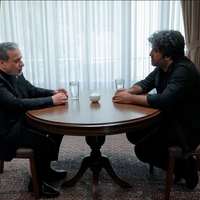
The last days of his hunger strike coincided with the visit of Iran’s deputy foreign minister Ali Bagher-Kani to the Foreign Office to discuss Iran’s nuclear talks.
Following the diplomatic meeting, Ratcliffe met British minister for the Middle East James Cleverly on Thursday but came out of the meeting disappointed.
"If I'm honest, quite a depressing meeting," Ratcliffe told reporters after he left the Foreign Office, adding that Cleverly told him the meeting with Bagheri-Kani had been cordial.
Ratcliffe will stay in hospital for medical checks and released.

The Iran Atrocities Tribunal in London, quoting unnamed “European sources”, says Iran’s nuclear negotiator demanded that Britain stop the work of the Tribunal.
The official Twitter channel of the Tribunal, launched by human rights defenders, reported on Friday that Ali Bagheri-Kani, Iran’s deputy foreign minister and chief nuclear negotiator who visited the UK Foreign Office on Thursday threatened to stop part of his nuclear talks with world powers if the Tribunal continued its workd.
The tribunal, organized by several human rights groups convened in London from Wednesday to Saturday to examine the atrocities and violence against protesters in Iran in November 2019, during which hundreds of unarmed demonstrators were killed by security forces.
Multiple witnesses from Iran and abroad testified during the Tribunal, recounting how security forces used violence against protesters and presenting evidence on the role of Iran’s top leaders in ordering the violence.
Bagheri-Kani was on a tour of European capitals this week in the runup to a new round of talks aimed at reviving the 2015 nuclear agreement known as the JCPOA. Iran has hardened its posture in recent days, demanding that the United States lift all sanction at once prior to the conclusion of the talks.

In the third day of the Iran Atrocities Tribunal in London the brother of a victim who was killed by security forces in the November 2019 protests testified.
Two human rights experts who have followed the aftermath of the protests and have documented atrocities, as well as a doctor who was on duty during the protests testified.
Bahar Saba, a researcher from Amnesty International told the Tribunal that weapons used by security forces in the protests show that they intended to kill unarmed demonstrators.
The tribunal, organized by several human rights groups convened in London Wednesday to examine the atrocities and violence against protesters in Iran in November 2019. Iran declined an invitation from the organizers to take part.
Saba also told the panel of judges that security forces had fired tear gas into homes where children were present and fired pellet guns at underage people in the streets. A 16-year-old lost his eye as a result.
Shadi Sadr, a human rights expert and activist representing Justice for Iran, said that her organization had collected 2,298 videos of the protests showing violence and killing of demonstrators and onlookers in 86 cities and 29 provinces. After verifying the images, in 310 videos shooting was audible or dead bodies could be seen.
In the morning session, witness number 31, whose bother was shot dead by security forces, testified. He said that the military prosecutor at the time refused to name the officer responsible for his brother’s death but told him “We will deal with him.” Later, the family received information from the military court that security forces had fired 700 bullets at protesters, despite initial denials.
The witness, whose identity was disguised to protect his security in Iran, said that on the day of his brother’s burial, the police closed schools around the cemetery and took up position on the roofs, ready to open fire in case of any spontaneous protests.
A doctor, who testified from Iran and was tagged as witness 109, said that security agents were canvassing patients to identify any wounded protesters and were not allowing the hospital to admit any casualties from the protests.
The four-day Tribunal heard numerous testimonies or recorded videos from Iran. The organizers say that Iranian officials who ordered security forces to kill protesters should remain unpunished. They demand the United Nations forms an investigative committee to look into the violence that killed hundreds of unarmed protesters. Reuters reported in December 2019 that Supreme Leader Ali Khamenei had ordered to suppress the protests and up to 1,500 people were killed.

Scores of Iranian Kurds have been arrested in two regions in the Iranian Kurdistan province, two human rights monitoring groups reported on Friday.
Several residents in villages around the town of Saqez were rounded up by security forces and taken to an unknown location, Hengaw, a Kurdish rights group said. Abdollah Mahjuz, a former political prisoner and his cousin Mohammad Mahjuz were among those detained.
The reason for the arrests is not clear, but security forces regularly detain Kurdish citizens on suspicions of political activities or membership in underground groups.
Hengaw also reported that 20 people were arrested around the town of Baneh in Kurdistan. The Kurdistan Human Rights Network, another monitoring group, also reported that dozens of agents in civilian clothes stormed several other villages near Baneh and arrested ten people. Local sources told the rights group that agents entered home and after confiscating personal items, detained citizens with verbal and physical violence. In some cases, agents beat up family members who prevented their illegal entry into their homes.
These reports also said that security personnel are present in Baneh’s streets and nearby villages.